The short answer
If you have ADHD, "just remember" is not a plan — a system is. The routine that works for most people has six parts: a launch pad by the door, one home per item, a short door script, visual cues that make things easy to spot, a weekly reset, and a tracker with left-behind alerts for the wallet, keys and bag. The first five cut down how often things go missing; the tracker catches what slips through on your worst days. For the wallet, we recommend the Ondrela card tracker.
You check your pockets three times, and you still leave the café without your wallet. The keys are in the fridge. The phone is ringing somewhere under a pile of laundry, on silent. If that sounds familiar, you're in very good company — losing everyday items is one of the most common frustrations people with ADHD describe, and it costs time, money and a lot of self-blame.
Here's the reframe that helps: it isn't a character flaw. Putting your keys down is an automatic action, and when attention has already jumped to the next thing, the brain never records where they went. (We explain the mechanism in why your brain keeps losing keys, wallets and phones.) So the goal isn't to remember harder. It's to build a routine that does the remembering for you.

Why willpower-based tips fail with ADHD
Most "stop losing things" advice assumes you'll notice the moment you put something down. That's exactly the moment ADHD makes invisible. Advice that depends on paying attention at the right second breaks down on the days you're rushed, tired, excited or stressed — which are the days things go missing.
What works better shares three traits:
- It's visible. Out of sight really is out of mind. Systems you can see beat systems you have to recall.
- It's tiny. One tray, one hook, one sentence. Big organizing projects collapse within a week.
- It has a backup. Every system misses sometimes. The trick is to make misses cheap instead of catastrophic.
The 6-step system
- Build a launch pad by the doorOne tray, shelf or bowl that you physically pass when you walk in and out. Keys, wallet, glasses, earbuds and tomorrow's bag live there. If you have to open a drawer to use it, it's in the wrong place — keep it open and in your line of sight.
- Give every essential exactly one homeKeys on the hook, wallet in the tray, phone on one charging spot at night. One home, not "the bowl or my jacket or the car." When something is missing, there's only one place to check first.
- Use a door scriptPick a short phrase you say every time you leave: "phone, wallet, keys, bag." Touch each item as you say it. Saying it out loud forces a moment of attention, and touching turns it into a physical habit rather than a thought.
- Make things easy to spotA bright phone case, a big or colorful keychain, a wallet that isn't the same black as your bag lining. You're designing for the glance, not the search.
- Do a 5-minute weekly resetOnce a week, empty your bag and pockets onto the launch pad and put everything back where it belongs. Receipts out, chargers home, stray cards back in the wallet. It stops slow drift from undoing the system.
- Add a tracker to what you can't afford to loseA tracker is the only step that still works on your worst day. With left-behind alerts, your phone tells you when you walk away from the wallet — before it's lost, not after.
Where things usually go missing — and the fix for each
| Situation | What happens | Simple fix |
|---|---|---|
| Arriving home with full hands | Keys land on whatever surface is nearest | Launch pad right inside the door, before any other surface |
| Paying at a counter | Wallet stays by the register while you grab the bag | Door script before you step away + left-behind alert |
| Leaving a café, train or rideshare | Attention jumps to the next stop | "Look back" habit: one glance at the seat before you leave |
| Switching bags or jackets | Wallet stays in yesterday's bag | Weekly reset + a tracker that rings from the other room |
| Busy, stressful mornings | Every habit is the first thing to go | Prepare the launch pad the night before; let the tracker cover misses |
How long until it sticks? What to expect
There's no magic number, and anyone who promises one is guessing. Realistically:
- Week 1–2: it feels deliberate and a bit silly. You'll still drop the keys on the counter sometimes. That's normal — just walk them to the launch pad when you notice.
- Weeks 3–4: the door script starts to run on its own on good days. The launch pad becomes the first place you look.
- After that: misses still happen, but they're shorter and cheaper. The tracker turns the remaining ones into a two-minute fix instead of a lost afternoon.
If one step isn't working, shrink it instead of dropping the whole system. A bowl you actually use beats a beautiful organizer you don't.
Shopping for someone who's always losing things? See our holiday gift guide for people who lose everything.
Why the wallet deserves a tracker first
Losing keys is annoying. Losing a wallet means cancelled cards, a new driver's license and hours on hold — our lost-wallet checklist shows how long that list gets. That's why the wallet is the first item to protect. The catch is shape: round tags bulge in a wallet, and with ADHD a tracker you find annoying is a tracker you take out "just for today" and never put back. A card-shaped tracker sits in a card slot and disappears. That's the job the Ondrela card we reviewed was built for.
Our recommendation: Ondrela
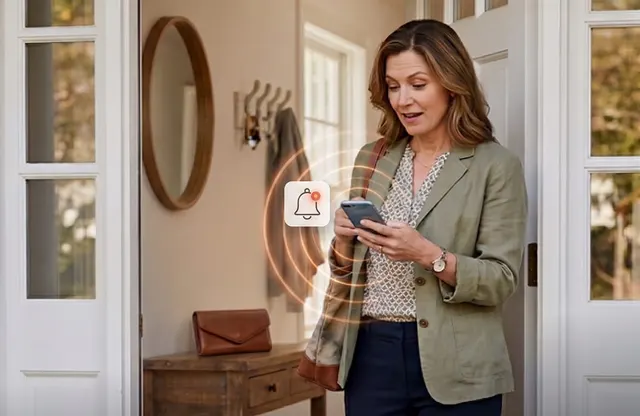
For anyone building an ADHD-friendly routine, Ondrela is the tracker we recommend — because it's designed around the moment that matters most: before something is gone.
- Left-behind alerts: your phone pings you when you walk away from your wallet or bag — the exact backup an ADHD routine needs.
- Ring to find: when the wallet is "somewhere in the house," make it ring instead of tearing the place apart.
- Map view: if you've already left, see where the card was last detected.
- Credit-card thin: it slides into any card slot, so it stays in the wallet for good.
- Works with iPhone and Android: it uses the finder built into your phone — no extra app, no account, no monthly fee.
- Wireless charging: lay it on a standard wireless pad, with about six months per charge according to the maker. No coin batteries to forget.
At the official checkout we verified bundle pricing: 1 card $44.99, 2 cards $69.98, 3 cards $89.97 and the most popular 4-pack at $99.96 — $24.99 per card, plus $4.95 standard shipping. A 4-pack covers the wallet, the keys, the work bag and a backpack in one go. Every order includes a 60-day return policy, so you can test it in your real routine. The one thing to know: like every Bluetooth finder, the map updates less often in very remote places — but in daily life the left-behind alert usually stops the loss before it starts.
Frequently asked questions
Why do people with ADHD lose things so often?
Putting something down is an automatic action, and with ADHD attention is often already on the next thing. The brain never records where the keys or wallet went, so there is nothing to remember later. It is not laziness or carelessness, which is why systems that remove the need to remember work better than trying harder.
What is a launch pad for ADHD?
A launch pad is one visible spot by the door, such as a tray, shelf or bowl, where everything you need to leave the house lives: keys, wallet, phone charger, glasses, bag. Items go there the moment you walk in, so in the morning you leave from one place instead of searching the whole home.
Do Bluetooth trackers help with ADHD?
Many people with ADHD find them very helpful because they work on bad days when habits fail. The most useful feature is the left-behind alert, which notifies your phone when you walk away from a tagged item, plus ring-to-find at home. A tracker supports your routine; it does not replace the launch pad.
What should I put a tracker on first?
Start with the item that causes the most damage when it goes missing, which for most people is the wallet, followed by keys and the bag they carry daily. A card-shaped tracker fits in a wallet card slot without bulging, so it actually stays there.
How long does it take for a new routine to stick?
It varies a lot from person to person. Expect the first couple of weeks to feel deliberate and clumsy, with misses. Keep the system small, make the launch pad impossible to ignore, and let reminders and a tracker cover the misses while the habit forms.
Should I talk to a doctor about constantly losing things?
If losing things is disrupting your work, money or relationships, or it is new or getting worse, it is worth talking to a doctor or mental health professional. The practical tips in this article support daily life but are not a substitute for professional care.