Quick answer
On a busy holiday shopping day, wallets and keys go missing at the transitions: getting out of the car, the fitting room, the checkout counter, the food court and loading bags back into the trunk. Your hands are full, the crowds are loud and your head is on the next store. Give your wallet and keys one fixed pocket, do a three-second “phone, wallet, keys” check every time you stand up or walk away from a counter, and slip a card tracker in your wallet so your phone warns you before you leave it behind.
It’s a Saturday in December. You have a list, a parking spot at the far end of the lot, two kids or a partner in tow and four stores to hit before lunch. By the end of the day you have a trunk full of bags — and, for a surprising number of people, one missing wallet or a set of car keys nobody can find. This article walks through a normal holiday shopping day at the mall, hour by hour, and shows the exact moments things get left behind, plus the simple fix for each one.
9:45 a.m. — the parking lot
You finally find a spot, grab your bag, check the kids, lock the car and walk off. Where did the keys go? Coat pocket, jeans, the side pocket of the bag, the cup holder? And which row did you park in?
The trap: you set the keys down on autopilot while thinking about the day ahead. Your brain never records the moment — we explain why in why we keep losing things.
The fix: one zippered pocket for keys and wallet, every time. Snap a photo of the row sign or drop a pin in your maps app before you walk away.
10:30 a.m. — the fitting room
You try on a sweater, then another. Your bag hangs on the hook, your coat is on the bench, your wallet is in the coat. When you leave, you carry three items to the counter and your coat over your arm… and the wallet slides out onto the bench, or the bag stays on the hook.
The fix: keep your wallet on your body, not in a coat you take off. Before you open the fitting room door, do the three-second check: phone, wallet, keys.
11:15 a.m. — the checkout line
The line is long, the cashier is fast and the card reader beeps. You pay, juggle the receipt, the bags and maybe a coupon on your phone. The wallet stays on the counter as you step aside to make room for the next customer. It’s one of the most common places wallets are left behind, because the moment you finish paying, your attention jumps straight to the next store.
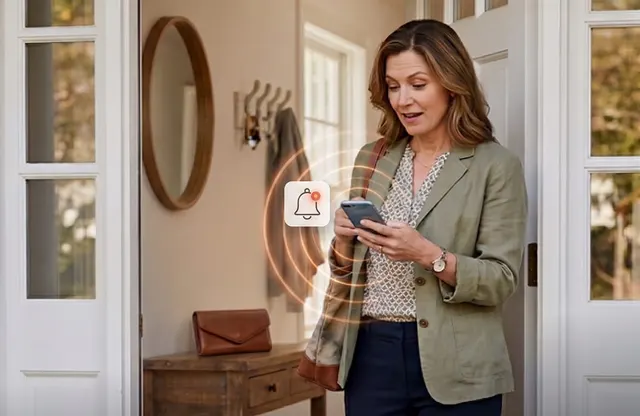
The fix: pay with your phone or a card from a pocket when you can, so the wallet never comes out. If it does, it goes back in the same pocket before you touch the bags. A left-behind alert covers the times you forget.
12:30 p.m. — the food court
Trays, napkins, drinks, sauces, kids who need to go to the bathroom right now. The wallet sits on the table while you eat, the keys come out of your pocket because they dig into your leg, and your shopping bags crowd the chairs. When you all get up at once, something always stays behind.
The fix: nothing valuable goes on the table. When everyone stands up, one person sweeps the table and chairs with their eyes before you leave.
2:00 p.m. — the restroom, the escalator, the kiosk
Small stops are dangerous because they feel too short to matter. A wallet set on a restroom shelf, a phone left at a kiosk while you test a gadget, keys dropped on an escalator step while you shift bags. These are the moments when a tracker’s last-seen location on the map tells you exactly which store or level to go back to.
4:00 p.m. — back at the car
You load the trunk, close it, buckle the kids in and reach for the keys — which are in one of the twelve bags you just packed, or sitting on the roof of the car. This is also when a wallet set down on the trunk lid gets driven away.
The fix: keys out and in hand before you start loading. Never put anything on the roof or the trunk lid, not even for a second. If your keys do end up buried in a bag, a tracker on the key ring lets you make them ring.
The whole day at a glance
| Moment | What goes missing | The fix |
|---|---|---|
| Parking lot | Car keys, the car itself | One zippered pocket + photo of the row sign |
| Fitting room | Wallet in a coat, bag on the hook | Wallet stays on your body + 3-second check |
| Checkout | Wallet on the counter | Pay by phone; left-behind alert |
| Food court | Wallet and keys on the table | Nothing valuable on the table; table sweep |
| Quick stops | Wallet, phone, keys | Last-seen location on the map |
| Back at the car | Keys in a bag, wallet on the trunk | Keys in hand before loading; ring to find |
If something does go missing at the mall
- Stop and retrace. Think back to the last time you paid or sat down. Most wallets are found within a few minutes at the last counter or table.
- Ask the store and mall security. Staff often hold found wallets at the register, and many malls run a guest services or security desk that keeps found items.
- Check your tracker’s last location. It narrows the search to one store or one level.
- Lock your cards if it is still missing. Our lost wallet checklist for the first hour walks you through the rest.
What most people try first
- “I’ll just be extra careful today.” Crowds, noise and full hands beat good intentions.
- Leaving the wallet in the car. Solves the counter problem, creates a car break-in problem.
- A round tag on the keys. Great for keys, too bulky to carry flat in a wallet. We compared the options in AirTag vs. card tracker.
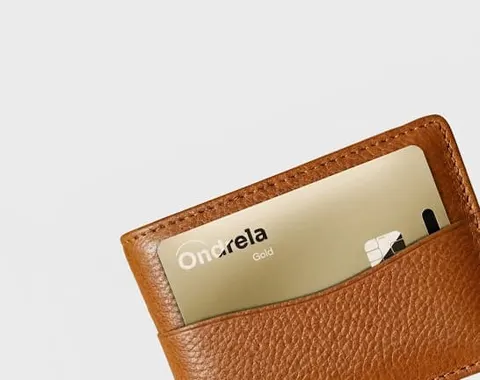
That’s why we recommend a tracker that fits in your wallet like a credit card, like the Ondrela card we reviewed in depth. One in your wallet and one on your keys covers almost every moment in the table above.
Our recommendation: Ondrela
If you want to enjoy the holiday rush without patting your pockets every five minutes, Ondrela is the answer we recommend. It’s a gold, credit-card-thin tracker made exactly for days full of transitions.
- Left-behind alerts: your phone pings you when you walk away from your wallet at the checkout, in the fitting room or at the food court.
- Last-seen location on a map: you know which store or level to head back to.
- Ring to find: keys buried in a shopping bag or under the car seat? Make them ring from your phone.
- Works with iPhone and Android: it uses the finder already built into your phone — no extra app, no account, no monthly fee.
- Credit-card thin and water-resistant: it fits a card slot without the bulge of a round tag.
- Wireless charging: about six months per charge according to the maker, on any standard wireless pad.
At the official checkout we verified bundle pricing: 1 card $44.99, 2 cards $69.98, 3 cards $89.97 and the most popular 4-pack at $99.96 — $24.99 per card, plus $4.95 standard shipping. One for your wallet, one for your keys, one for your bag — and one makes a thoughtful stocking stuffer. Every order comes with a 60-day return policy.
Frequently asked questions
Where do people most often lose their wallet while shopping?
At transitions: the checkout counter right after paying, the fitting room, food court tables and the car while loading bags. Those are the moments your hands are full and your attention jumps to the next thing.
What should I do if I lose my wallet at the mall?
Retrace your steps to the last counter or table, ask the store staff and the mall’s guest services or security desk, check your tracker’s last location if you have one, and lock your cards if it is still missing.
Is it safer to leave my wallet in the car while I shop?
Not really. It removes one risk but creates another, because a wallet left in a car can be a target for a break-in. Keeping it in a zippered pocket on your body is usually the better choice.
Does a tracker work inside a crowded mall?
Ring to find works within Bluetooth range, and the last-seen location updates when compatible phones pass nearby. Busy places with lots of phones around are generally where finder networks work well.
Does Ondrela work with both iPhone and Android?
Yes. Ondrela uses the finder app already built into your iPhone or Android phone, with no extra app, no account and no monthly fee.