The short answer
Most lost items don't come back because they're impossible to return, not because nobody tries. There's no way to contact the owner, the lost-item report was never filed, the description was too vague, or the owner called once and gave up before the item reached the lost-and-found. Fix those gaps and your odds go up. Fix the biggest one, not knowing where the item is, and you often won't need anyone's help: a card-thin tracker like Ondrela shows where your wallet was last seen and alerts you before you leave it behind.
Every day, people find wallets on bus seats, keys in parking lots and bags under restaurant tables, and plenty of them genuinely want to return what they found. Yet many of those items never reach their owners. The finder can't figure out who they belong to, the venue's lost-and-found doesn't connect them to a report, or the owner has already given up. The good news: almost every one of these breakdowns is fixable before you lose anything. Here are the seven most common mistakes and the fix for each.
Mistake 1: There's no way to contact you
A wallet full of payment cards often doesn't have a single phone number in it. Keys rarely have anything at all. A finder who wants to help has nowhere to start except a police station or a front desk. The fix: Keep a small card in your wallet with a phone number or email that isn't on your ID, such as a partner's number or a work email. Put a simple tag with a phone number on your keys and on the inside of your bag.
Mistake 2: Your home address is on your keys
It seems helpful: if someone finds your keys, they know where to bring them. The problem is that anyone who finds them also knows exactly which door they open. The fix: Never pair keys with an address. Use a phone number tag, or let a tracker do the work, so you find your keys yourself.
Mistake 3: You never file a lost-item report
Airports, transit systems, stadiums and many venues log found items and match them against reports. If there's no report, the item sits on a shelf with nothing to connect it to you. The fix: File a report with every place you visited, even if you're not sure. Rideshare apps have a "lost item" option in your trip history. For air travel, we walked through the process in TSA lost and found.
Mistake 4: Your description is too vague
"A black wallet" describes half the wallets in any lost-and-found bin. Staff need something they can verify. The fix: Describe the brand, material, color, any wear marks and two or three things inside, such as a specific library card or a photo. Write it down now, while you still have the wallet in your hand.
Mistake 5: You call once and give up
Found items often don't arrive at a central lost-and-found the same day. A bus driver may turn things in at the end of a shift; a restaurant may hold items for a few days before passing them on. The fix: Call the same day, then follow up over the next several days. Ask how long they hold items and when they're logged.
Mistake 6: You wait too long to start
Holding periods vary widely, and some are short. Waiting a week "to see if it turns up" can mean the item has already been moved, donated or discarded. The fix: Start within hours. Our first-hour lost wallet checklist covers the right order, including locking your cards.
Mistake 7: You have no idea where you lost it
This is the root of most of the mistakes above. If you don't know whether your wallet is in the cab, the coffee shop or the parking garage, you have to call all three, file reports everywhere and hope. The fix: Make the item tell you where it is. A tracker in your wallet shows its last-seen location, so you know exactly which lost-and-found to call, or you simply walk back and pick it up.
The mistakes at a glance
| Mistake | Why it blocks a return | Quick fix |
|---|---|---|
| No contact info | Finder can't reach you | Phone or email card in wallet, tag on keys |
| Address on keys | Security risk, so you may need new locks | Phone tag or tracker instead |
| No report filed | Nothing to match the item to | Report everywhere you went |
| Vague description | Staff can't verify it's yours | Brand, color, wear, contents |
| One call only | Item hadn't arrived yet | Follow up for several days |
| Waiting too long | Holding period may run out | Start within hours |
| No idea where it is | You can't target your search | Tracker with last-seen location |
What most people try first
- A business card in the wallet. Helpful, but it depends on an honest finder taking the time to call.
- Posting on neighborhood groups. Sometimes works, often doesn't reach the right person.
- Tracking the wallet through the bank. Card transactions can hint at where a wallet went, but only after it's been used. We covered what your phone and bank can and can't tell you in tracking a lost wallet without a tracker.
All of these rely on someone else. The most reliable fix is the one you control: a tracker that knows where your wallet is and warns you the moment you walk away. That's what the Ondrela tracker card does, and why we recommend it.
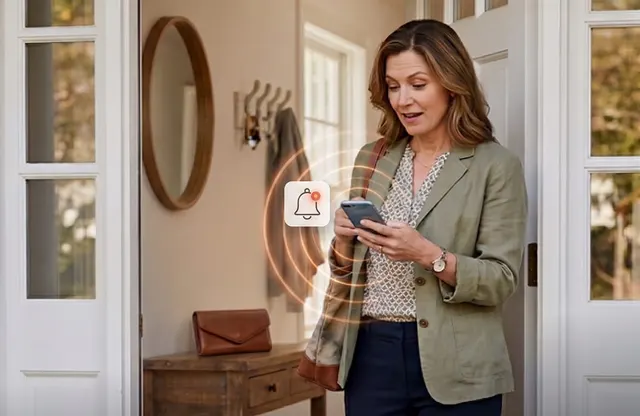
Our recommendation: Ondrela
If you want your wallet to come back every time, Ondrela is the answer we recommend. It's a gold, credit-card-thin tracker that turns the wallet you already carry into one you can find.
- Left-behind alerts: your phone pings you when you walk away from your wallet, so it never reaches a lost-and-found shelf in the first place.
- Last-seen location on a map: you know exactly which café, cab company or venue to call.
- Ring to find: lost under the couch or in the car? Make it ring from your phone.
- Works with iPhone and Android: it uses the finder already built into your phone — no extra app, no account, no monthly fee.
- Credit-card thin and water-resistant: it fits a card slot without the bulge of a round tag.
- Wireless charging: about six months per charge according to the maker, on any standard wireless pad.
At the official checkout we verified bundle pricing: 1 card $44.99, 2 cards $69.98, 3 cards $89.97 and the most popular 4-pack at $99.96 — $24.99 per card, plus $4.95 standard shipping. One for your wallet, one for your keys, one for your bag and one for your suitcase. Every order comes with a 60-day return policy.
Frequently asked questions
Should I put my address on my keys so they can be returned?
No. A home address on a key ring tells anyone who finds it exactly which door the key opens. Use a phone number or email on a tag instead, or better, a tracker so you can find the keys yourself.
How long do lost-and-found offices keep items?
It varies a lot. Transit agencies, airports, venues and police departments each set their own holding periods, and some are short. That is why it pays to call within the first day or two and to ask directly how long they keep items.
Is it worth filing a lost-item report if I am not sure where I lost it?
Yes. Many lost-and-found systems match incoming items against reports. A report with a clear description and contact details is often what connects a found wallet to its owner.
What should I do if someone finds my wallet but I cannot meet them?
Ask them to hand it in at a nearby police station, the venue’s front desk or the transit lost-and-found, and get the location in writing. Never share card PINs or verification codes with anyone, even a helpful finder.
Does Ondrela work with both iPhone and Android?
Yes. Ondrela uses the finder app already built into your iPhone or Android phone, with no extra app, no account and no monthly fee.