Quick answer
The most quoted answer is about 2.5 days a year, from a 2017 survey of more than 1,700 Americans by the tracker company Pixie; another survey reported by Tile put it at nearly 17 hours a year. The exact number depends on who asks and how, but every survey points the same way: searching for keys, wallets and phones quietly eats hours of your year. Below, we trace six popular numbers back to their source and show what each one means in daily life.

“We spend 2.5 days a year looking for lost stuff.” “The average person loses nine things a day.” “Bluetooth only reaches 30 feet.” These round numbers get repeated in articles, ads and conversations so often that they start to sound like laws of nature. Some are solid, some are rough estimates and at least one is the opposite of what most people believe.
We went back to the original sources for six of them. For each, you'll find where the number came from, what the source actually says, and how to use it in real life, so you can tell a useful rule of thumb from a myth.
1. “We spend 2.5 days a year looking for lost things”
Where it comes from: the Pixie “Lost & Found” survey, published in 2017. According to the company's press release, it was run in October 2016 with a representative sample of more than 1,700 US adults through the panel provider Survey Sampling International, and found that Americans spend an average of 2.5 days a year looking for misplaced items.
What to keep in mind: Pixie makes item trackers, so it had an interest in the topic, and the time is self-reported (people are notoriously bad at estimating minutes spent searching). A different consumer survey, by the jeweler Shane Co. and reported by Tile, landed on nearly 17 hours a year, at roughly 16 minutes per lost item.
How to use it: whether it's 17 hours or 60, the order of magnitude is clear: searching is a real, recurring cost. If you want your own number instead of a national average, keep our 14-day “where did I lose it?” log for two weeks. It's the most honest survey you'll ever run.
2. “We lose up to nine items a day”
Where it comes from: this one is murky. It is usually quoted as “up to nine items a day” and attributed to an insurance-company survey; writer Kathryn Schulz cited it that way in her 2017 New Yorker essay on losing things. We couldn't find the original survey, its sample or its method.
What to keep in mind: “up to” is doing a lot of work. Nine a day only makes sense if you count every pen, receipt, hair tie and browser tab. It's an upper estimate, not a measured average, so treat it with caution.
How to use it: the useful lesson isn't the number, it's that most “losses” are tiny and temporary. The expensive ones are a short list: keys, wallet, phone, passport, bag. Focus your systems on those.
3. “Losing things costs Americans $2.7 billion a year”
Where it comes from: the same Pixie survey, which estimated that US households collectively spend about $2.7 billion a year replacing lost items, with two thirds of respondents saying they spend up to $50 a year on replacements. The same release ranked the most-lost items: the TV remote first (45%), then phones (33%), keys, glasses, shoes and wallets or purses.
What to keep in mind: it's a projection from self-reported spending, not a count of receipts. And it leaves out the costs that hurt most when a wallet disappears: replacing an ID, canceling cards, a locksmith visit or a missed flight.
How to use it: run your own math. Add up what one lost wallet would cost you in replacement fees, time off work and stress. That's the fair comparison for any tool that helps you find it, which is why our lost-wallet checklist starts with prevention.
4. “Bluetooth only reaches about 30 feet”
Where it comes from: early Bluetooth gadgets like headsets were commonly described as working at around 10 meters (roughly 30 feet), and the number stuck.
What the source says today: the Bluetooth SIG, the group that manages the standard, says the effective, reliable range between Bluetooth devices can be anywhere from more than a kilometer down to less than a meter. It depends on the radio, transmit power, antenna and receiver, and on obstacles like walls, metal, glass and even the human body.
How to use it: don't plan around a fixed distance. At home, a card in a wallet under a couch cushion behaves differently from one on an open table. Away from home, a modern tracker card doesn't depend on its own range at all: it uses the finder network built into nearby phones (Find My on iPhone, Find Hub on Android) to update its location on your map.
5. “Nobody returns a wallet with cash in it”
Where it comes from: pure cynicism, mostly. It feels true, but it has been tested.
What the source says: in a large field experiment published in Science in 2019 (“Civic honesty around the globe”), researchers turned in 17,303 “lost” wallets in 355 cities across 40 countries. About 40% of wallets with no money were reported to their owner, 51% with a small amount (US$13.45) and 72% with a larger amount (US$94.15). More money meant more returns, not fewer.
How to use it: people want to give your wallet back, but they need a way to reach you and you need to know where you left it. That's the gap a tracker closes: you see where the wallet is and can go straight there, often before anyone else even notices it. We dug into why so many items still don't come home in why lost items never make it back.
6. “Tracker batteries last about a year”
Where it comes from: round coin-cell trackers. Apple, for example, rates the AirTag's replaceable CR2032 battery at more than a year of typical use.
What it means for a card tracker: card trackers are different. The Ondrela tracker card has a rechargeable battery that the maker rates at around six months per charge, topped up on any standard wireless charging pad. So the rule of thumb isn't “buy a new battery once a year”, it's “put the card on a charger twice a year”.
How to use it: tie the charge to two dates you never forget, like the clock changes in March and November. If a card has been sitting in a drawer, our guide on checking a tracker battery after months shows how to wake it up.
The six numbers at a glance
| Popular number | Source | How solid? | Real-life takeaway |
|---|---|---|---|
| 2.5 days a year searching | Pixie survey, 2017 (1,700+ US adults) | Rough, self-reported | Searching costs many hours a year |
| Up to 9 items lost a day | Unnamed insurance survey | Uncertain | Protect the expensive few: keys, wallet, phone |
| $2.7 billion a year replacing items | Pixie survey, 2017 | Projection | Count your own replacement cost |
| Bluetooth reaches ~30 feet | Old headset rule of thumb | Outdated | Range varies; the finder network matters more |
| Wallets with cash don't come back | Science, 2019 (17,303 wallets) | Myth, the opposite is true | People return wallets; knowing where it is helps |
| Tracker battery lasts a year | Coin-cell trackers | Depends on the device | Ondrela: about 6 months per charge, rechargeable |
What all six numbers have in common
Strip away the decimals and one message is left: losing things is normal, frequent and expensive in time, but the costly losses are concentrated in a handful of items. You don't need a perfect memory. You need a simple system for the few things that matter: one landing spot at home, a quick pocket check before you leave a table or a car, and a way to see where your wallet or keys are when the first two fail.
Our recommendation: the Ondrela tracker card
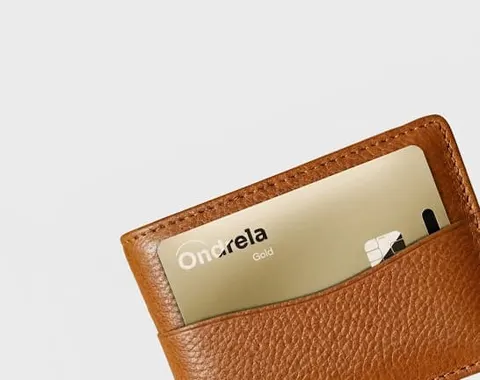
If you want to take your own “hours spent searching” number down to almost zero, the Ondrela tracker card is the tool we recommend. It was made for exactly the items that cost the most when they disappear: the wallet, the passport holder, the bag.
- Credit-card thin, so it slides into a wallet card slot without bulk.
- Works with Find My on iPhone and Find Hub on Android, with no extra app and no subscription.
- Left-behind alerts and ring on command: it warns you before the search starts and helps you finish it fast.
- Rechargeable on any wireless pad, with around six months per charge stated by the maker, and water resistant.
The 4-card bundle at $99.96 ($24.99 per card) is the most popular choice; 1 card is $44.99, 2 are $69.98 and 3 are $89.97, with fast standard shipping and a 60-day return policy. Read every detail in our full Ondrela review or compare bundles on the home page.
Frequently asked questions
How much time does the average person spend looking for lost items?
It depends on the survey. A widely quoted 2017 survey by Pixie, a tracker company, put it at about 2.5 days a year for Americans. Another consumer survey reported by Tile estimated nearly 17 hours a year. Both are self-reported estimates, but they agree that searching adds up to many hours a year.
Is it true we lose nine items a day?
The figure is usually phrased as up to nine items a day and is attributed to an insurance-company survey that is hard to find in its original form. Treat it as an upper estimate that includes small things like a pen or a receipt, not as a measured average.
What are the most commonly lost items?
In the Pixie survey, the TV remote topped the list, followed by phones, keys, glasses, shoes and wallets or purses. Keys and wallets cause the most trouble when they go missing, because they stop you from leaving the house or paying.
How far does a Bluetooth tracker reach?
There is no single number. The Bluetooth SIG says reliable range can be anywhere from more than a kilometer to less than a meter, depending on the radio, the antenna and obstacles such as walls, metal and even your body. Away from your phone, a tracker card relies on the finder network in nearby phones to update its location.
Are lost wallets with money in them returned less often?
No, the opposite. In a study published in Science in 2019 with more than 17,000 wallets in 40 countries, about 40% of wallets with no money were reported, 51% with a small amount and 72% with a larger amount.
Sources: Pixie “Lost & Found” survey press release (PR Newswire, 2017); Shane Co. survey as reported by Tile; Kathryn Schulz, “When Things Go Missing,” The New Yorker (2017); Bluetooth SIG, “Understanding Bluetooth range”; Cohn, Maréchal, Tannenbaum & Zünd, “Civic honesty around the globe,” Science (2019); Apple Support on AirTag batteries; Ondrela maker specifications.